
Have you ever sat down to study for 30 minutes, only to find yourself jumping between five browser tabs, replying to messages, scrolling through social media, and completely losing track of what you originally planned to do? You are not alone.
In today’s hyperconnected world, students face a challenge that previous generations never encountered: digital clutter. Notifications, overflowing inboxes, unused apps, scattered files, and constant distractions create mental noise that quietly erodes productivity and learning — often without you even noticing.
Research consistently shows that interruptions and task-switching significantly reduce concentration and increase the time needed to complete work. Small distractions may feel harmless in the moment, but over the course of a week, they can cost you hours of productive study time.
The good news? You do not need complicated systems or a dozen productivity apps to fix this. Minimalist study habits can help you build a cleaner digital environment, sharpen your focus, and support long-term academic success.
The Hidden Cost of Digital Clutter on Your Studies
Digital clutter is more than a messy desktop — it creates cognitive overload, the overwhelming feeling that your brain has too many things competing for attention at once.
Studies on attention and productivity suggest that regaining focus after even a brief interruption can take several minutes. Now imagine ten of those interruptions during a single study session. The lost time and mental energy add up fast.
Taming Your Inbox: Email Overload
Students receive a constant flood of announcements, assignment reminders, newsletters, and notifications every day. An overloaded inbox quickly becomes a source of anxiety rather than a useful tool.
Try these minimalist practices:
- Create simple folders: “Assignments,” “Important,” and “Read Later.”
- Unsubscribe from any email lists that do not serve your academic goals.
- Check your inbox only two or three times per day — not constantly.
Real Example: Instead of checking her inbox every 15 minutes, university student Sarah limited her email to 9 AM and 6 PM. Within a week, she noticed fewer distractions and felt calmer during study sessions.
Setting Boundaries with Social Media
Social media platforms are designed to capture — and hold — your attention. One quick check can easily turn into 20 minutes of unplanned scrolling.
Simple strategies that work:
- Turn off all non-essential notifications.
- Remove social media apps from your home screen.
- Schedule specific social media breaks, and stick to them.
Real Example: A student preparing for exams activates a “study mode” from 7 PM to 10 PM every evening, blocking all social media apps until the session ends.
Building Your Digital Sanctuary: Practical Steps
A focused digital environment does not happen by accident — it requires intentional, consistent choices.
Organize Your Digital Files Like a Pro
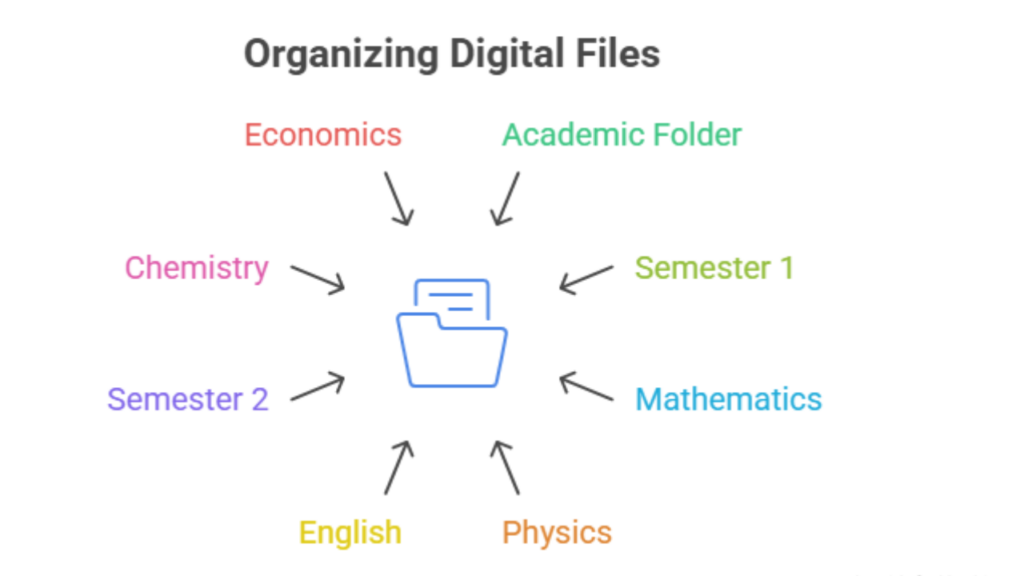
Hunting for a file when you need it breaks concentration and wastes time. A simple, consistent folder structure solves this instantly.
Recommended structure:
Academic Folder
├── Semester 1
│ ├── Mathematics
│ ├── Physics
│ └── English
└── Semester 2
├── Chemistry
└── Economics
Good file naming examples:
- Biology_Assignment_Week3
- Math_Notes_Chapter5
- History_Project_Final
Avoid names like:
- Finalfinal2.doc
- Notes_new_latest.doc
Consistent naming means you can find any file in seconds, not minutes.
Read Also:- How to Build a Consistent Study Routine Using an Online Focus Room
Embrace Single-Tasking
Many students believe multitasking makes them more efficient. Research tells a different story — multitasking consistently reduces both performance and information retention.
Instead of juggling:
- A music app
- A messaging app
- Ten browser tabs
- Multiple productivity tools
Simplify to:
- One note-taking tool (e.g., Google Docs or Notion)
- One browser window with only the tabs you need
- One task list
Less switching means more learning. It really is that simple.
Declutter Your Desktop and Home Screen
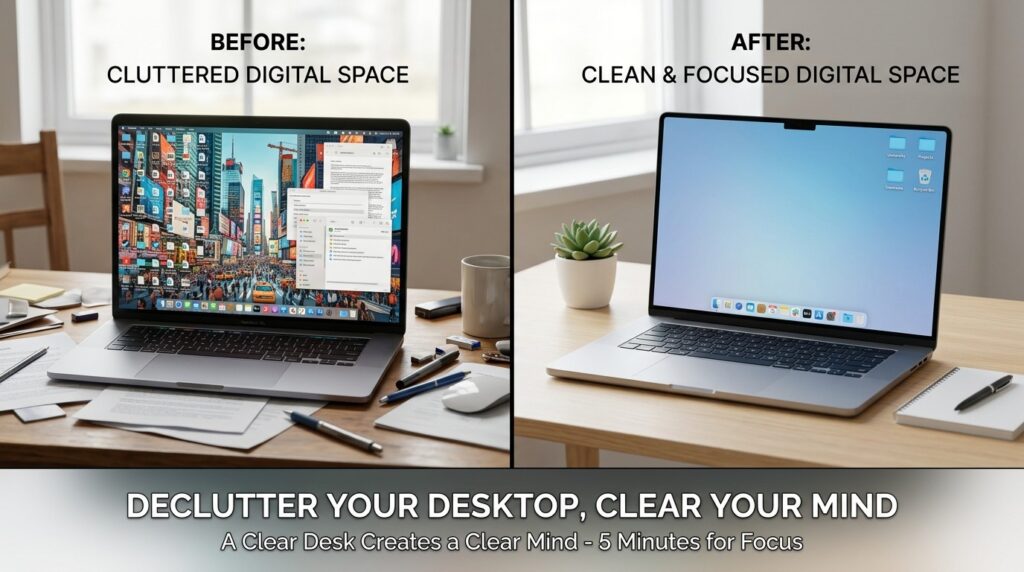
Your digital workspace directly influences your mental state. A cluttered screen signals chaos to your brain; a clean one signals focus.
Take five minutes to:
- Delete unused apps
- Clear out old screenshots
- Keep only study essentials visible
- Set a simple, distraction-free wallpaper
Think of your device the same way you would think of a physical study desk. A clear desk creates a clear mind.
Creating Sustainable Minimalist Study Habits
Minimalism is not about deleting everything — it is about keeping only what genuinely serves your goals.
Use the “One-Minute Rule”
If a small organizing task takes less than one minute, do it immediately rather than letting it pile up.
Examples:
- Rename a newly downloaded file
- Delete duplicate photos or notes
- Archive a completed assignment
- Move a download into the correct folder
Small, consistent actions prevent large, overwhelming messes.
Schedule a Weekly Digital Cleanup
Set aside 10 to 15 minutes every week to:
- Delete unnecessary files
- Organize notes from the week
- Close browser tabs you no longer need
- Review which apps are actually helping you
Weekly maintenance is far easier than a massive cleanup every month.
The Academic Payoff: Focus, Retention, and Success
Minimalist study habits deliver benefits that extend well beyond a cleaner screen.
Students who declutter their digital environment often experience:
- Better concentration during study sessions
- Lower stress levels throughout the semester
- Improved time management and task completion
- Higher productivity without longer hours
- Better information retention and exam performance
Consider this comparison:
| Student A | Student B | |
| Setup | 20 open browser tabs, active notifications | 1 browser tab, organized notes, notifications off |
| Study time | 2 hours | 2 hours |
| Deep focus time | Fragmented | Sustained |
| Outcome | Surface-level review | Deeper learning and better retention |
Both students study for the same amount of time — but Student B gets significantly more out of every session.
Success is not always about studying longer. It is about studying smarter.
Conclusion
Academic success rarely requires complex productivity systems or an endless collection of apps. Often, the biggest improvements come not from adding new techniques, but from removing the things that hold you back.
When you declutter your digital life, you create space for clarity, focused thinking, and intentional learning. Small, consistent changes — organizing your files, reducing notifications, simplifying your setup — compound into major results over a semester and beyond.
Minimalist study habits are not about achieving perfection. They are about building a system that keeps you focused on what truly matters: learning, growing, and reaching your academic goals.
Start with one small change today. Your future self will thank you.
Frequently Asked Questions (FAQ)
Q1: How do I start if I have years of digital mess to deal with? Start small and focus on one area at a time — your desktop, your downloads folder, or your email inbox. Progress matters more than perfection. Even one organized space creates momentum.
Q2: Will minimalist habits actually improve my grades? They can. Minimalist habits improve focus and reduce distractions, which increases the quality of your study time. Better-quality study sessions typically lead to stronger understanding and better exam performance.
Q3: What if I genuinely need multiple apps for my coursework? Use only the tools that provide clear, specific value. Avoid downloading several apps that serve the same function. If two apps do the same thing, keep the one that works best for you and delete the other.
Q4: How often should I do a digital declutter? A weekly review of 10 to 15 minutes is usually enough to maintain an organized system. Think of it like tidying your room — a little, regularly, beats a massive overhaul every few months.
Q5: Can digital minimalism actually reduce study stress? Yes. Fewer distractions and a cleaner digital environment create a sense of control and reduce mental overload. Many students report feeling calmer and more confident simply from organizing their digital workspace.
Ready to Supercharge Your Study Habits?
Minimalism becomes even more powerful when combined with the right support system.
Study Mates helps students build structured, focused learning experiences through collaboration, smarter study practices, and organized peer support. Instead of feeling overwhelmed by distractions and scattered routines, you can develop productive habits while learning alongside others who share your academic goals.
If you are ready for a smarter, more focused approach to studying, explore Study Mates and take the next step toward the academic success you deserve.
If you want to focus, then join us – https://studymates.live/